Leipzig: A unique study of children with congenital heart disease
The aim of the study is to close the existing data gap, enable children with congenital heart defects to participate safely in swimming activities, and potentially reduce unnecessary fears. An active lifestyle is especially important for children with cardiovascular diseases.
Until now, cardiology guidelines have partially imposed limitations on swimming participation for patients with congenital heart defects. The main reasons for this are the insufficient amount of scientific data and the resulting need for particular caution. Prof. Dr. med. Christian Paech, Executive Senior Consultant at the Heart Center Leipzig, explains:
"This topic has concerned us for quite some time, and through several preliminary studies we have been exploring whether a general restriction on swimming and diving is truly justified. The main challenge of the study lies particularly in collecting the necessary cardiovascular data in the water, as well as the lack of devices capable of measuring these parameters during active swimming. We are therefore very proud that, after intensive preparation, creative ideas, and technical support from various partners, we were able to successfully establish this unique study setup."
9-Year-Old Carlo Swims and Dives as Part of the Study
One of the participants in the study is 9-year-old Carlo. He was born with Tetralogy of Fallot, a complex congenital heart defect. The associated abnormalities lead to oxygen deficiency, which can be visible, for example, through bluish discoloration of the lips.
“We were informed about the congenital heart defect as early as the 12th week of pregnancy during prenatal diagnostics. At that point, it was already clear that our son would need heart surgery after birth. However, after delivery Carlo initially developed completely normally. Only at the age of six months did his oxygen saturation drop, and he underwent surgery at the Heart Center Leipzig,” recalls Carlo’s mother, Virginia Gruhne.
Shortly before his first birthday, Carlo underwent a second corrective surgery in Leipzig.
“Carlo is now 9 years old and very athletic. He plays in a volleyball club and also enjoys being in the water. That is why the study request was very interesting for us. In addition, I believe it is a wonderful thing that by participating we may also help other children with congenital heart defects,” adds his mother, Virginia.
A dataset collected for the first time worldwide
The study is conducted entirely under medical supervision. Emergency rescue equipment is always immediately available. Children with congenital heart defects from the age of six can participate in the study. Data is being collected from both healthy children and children affected by congenital heart defects. The data collection is carried out in cooperation with the Angerbrücke Therapy Center. In addition, the study is supported by both the German Heart Foundation and Kinderherzkammer.
Professor Christian Paech comments on the study:
“The data we are collecting is unique worldwide and therefore truly groundbreaking. Sports mean far more for children and adolescents than just physical activity. They strengthen self-confidence, encourage social interaction, and have a long-term positive impact on heart health. It would be disproportionate and unfair if children with congenital heart defects were partially prevented from swimming and diving simply because there is insufficient scientific data available. We believe that these affected children can swim without significant risk, and we now aim to support this assumption with reliable scientific evidence.”
The study was launched in January and is expected to continue until the end of June.
Innovative waterproof study design
In the first step, the so-called diving response is measured on dry land while holding the breath. Specifically, researchers observe changes in oxygen saturation, heart rate, and the perfusion index — meaning the constriction of peripheral blood vessels. During this test, the children try to hold their breath for as long as possible.
Next, the young patients immerse only their heads into a container of water, and the measurements are repeated. Around 80% of the diving response occurs immediately when the head is submerged and is transmitted to the corresponding receptors.
In the third step, the children dive in place, and data is collected during static apnea without physical exertion.
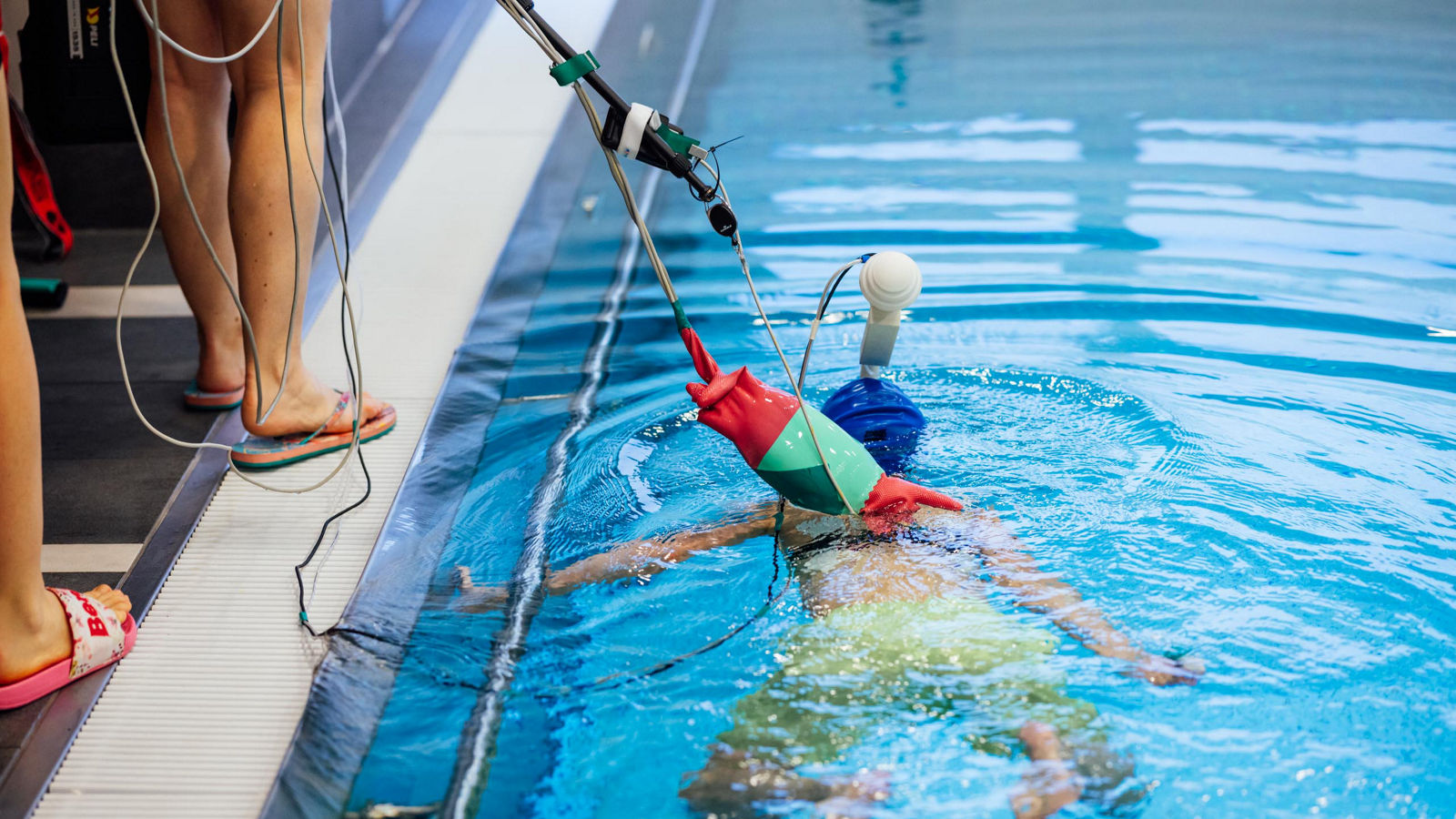
Afterward, spiroergometry is used to measure how much oxygen is absorbed and released both during swimming and diving. In addition to respiratory gases, the level of physical exertion is also measured.
“During the diving response, the heart rate decreases and blood is redistributed toward vital organs. When submerged, about ten percent of the blood volume is pushed centrally toward the heart due to water pressure. At the same time, blood vessels constrict to varying degrees depending on how cold the water is. Overall, the body attempts to conserve oxygen during diving. It is important to ensure that all these processes also function smoothly in children with congenital heart defects,” the expert explains regarding the body’s physiological changes during diving.
To ensure reliable data collection, various devices, such as ECG sensors, had to be waterproof sealed. This also makes the study setup innovative.
Read more:
Do you need more information about Helios Hospitals or want to schedule your treatment?