
Prostate cancer treatment with Lutetium-177 PSMA
PSMA therapy
PSMA, or prostate-specific membrane antigen, is a protein found in prostate tissue. However, it is expressed at significantly higher levels on prostate cancer cells than on healthy prostate cells. Modern medicine takes advantage of this characteristic in PSMA-targeted therapy.
In Lu-177 PSMA therapy, radioactive substances are administered to the patient via infusion or injection. These substances bind to PSMA, thereby delivering localized radiation to cancer cells using the radionuclide lutetium-177. Because the radiation travels only a few millimeters, a high and effective radiation dose can be delivered directly to the tumor tissue while largely sparing the surrounding healthy tissue. Side effects are generally limited, and the therapy is usually well tolerated.
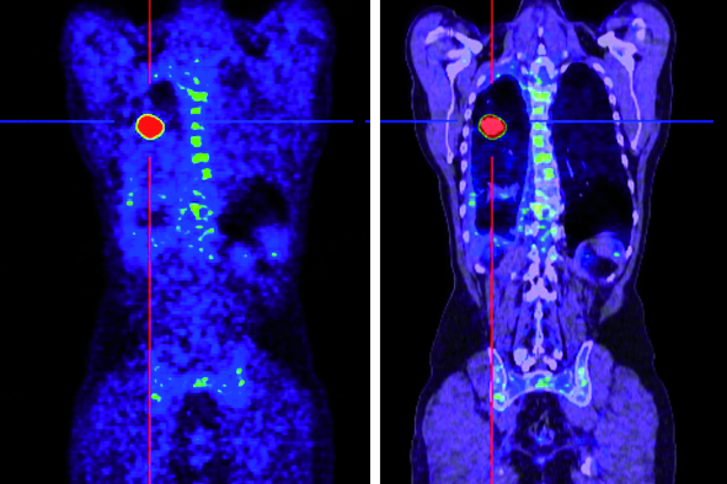
Before treatment begins and during the course of therapy, PET/CT scans are also performed. This imaging method likewise uses a radioactive substance that binds to PSMA, allowing cancer cells to be reliably identified. This enables precise visualization of prostate cancer, including its metastases, and provides a reliable basis for assessing the response to treatment.
Particularly in patients who have already developed bone metastases, lymph node metastases, or a local recurrence of prostate cancer, a significant reduction in these tumor lesions can often be observed. Another positive effect of the therapy is pain relief, which occurs in many cases and can contribute to an improved quality of life.
Treatment procedure
Lutetium-177 therapy is administered via infusion or injection over several treatment cycles, usually at intervals of approximately six to eight weeks. Each cycle involves an inpatient hospital stay of around two days. Results show that significant positive effects may already be achieved after two to three treatment cycles. In particular, further tumor growth may be stopped or the overall tumor burden may be reduced. According to recent studies, complete disappearance of tumor lesions has even been documented in individual patients.
During the procedure, the physician places an intravenous catheter in the patient’s arm. A saline solution is initially administered to support kidney function before treatment begins. The therapeutic agent is then administered by injection over approximately one minute.
Approximately 15–30 minutes after treatment, various nuclear medicine examinations, such as whole-body scintigraphy and SPECT/CT, are performed to document and monitor the distribution of radioactivity and measure radiation exposure to the kidneys. Additional gamma camera scans are performed after 24, 48, and 72 hours to document the course of treatment.
Preliminary examinations and contraindications
To determine whether this therapy is suitable for a particular patient, a detailed review of the patient’s medical history and course of disease is required. The following examinations are part of treatment planning and preparation:
- Ga-68 PSMA PET/CT to detect and measure PSMA uptake in the tumor and/or metastases;
- Tc-99m MAG3 renal scintigraphy to assess kidney function and rule out urinary tract obstruction, as the therapy may potentially affect renal function;
- blood tests to confirm adequate bone marrow reserve, assess liver and kidney function, and determine the PSA level.
Lutetium-177 therapy is contraindicated in patients with:
- severe renal impairment;
- urinary obstruction or retention;
- uncontrolled urinary incontinence;
- impaired bone marrow function;
- significant abnormalities in blood cell counts.
Risks and side effects
According to the available data, Lu-177 PSMA therapy is generally well tolerated. However, the following side effects may occur:
- nausea, vomiting, and diarrhea;
- impaired liver function;
- impaired kidney function, potentially progressing to renal failure in extremely rare cases;
- allergic reactions, in which case immediate emergency treatment is provided;
- impaired bone marrow function;
- impaired function of the lacrimal and salivary glands;
- significant changes in blood cell counts;
- secondary malignancies as a late complication of radionuclide therapy are considered unlikely but cannot be completely ruled out.
After treatment
Blood tests should be performed approximately two weeks after treatment, particularly a complete blood count and tests of liver and kidney function. This allows any potential side effects to be identified and managed promptly.
If Lu-177 PSMA therapy is well tolerated, six treatment cycles at eight-week intervals are usually planned. After two cycles of Lu-177 PSMA therapy, the response to treatment is assessed using Ga-68 PSMA PET/CT and MAG3 renal scintigraphy.
Inpatient stay
Patient rooms at Helios hospitals are equipped with everything needed for a comfortable stay, including a shower and toilet, television, telephone, bath amenities, and personal hygiene products.
The inpatient stay usually lasts three to four days. For radiation protection reasons, relatives are not permitted to stay in the patient’s room.
For greater comfort during the hospital stay, patients are advised to bring comfortable clothing. Books, a mobile phone, and a computer may also be brought if desired. Free Wi-Fi is available in the patient rooms.
Personal belongings and clothing brought to the hospital can usually be taken home after the inpatient stay.
Hospitals specializing in Lu-177 therapy
Arranging lutetium treatment for prostate cancer
The Helios team supports patients throughout every stage of arranging treatment in Germany — from selecting the appropriate hospital and reviewing medical records to coordinating the treatment program and scheduling a consultation or hospital admission. Submit your treatment request via the contact form or email, and a patient manager will contact you shortly to discuss the details.
Do you need more information about Helios Hospitals or want to schedule your treatment?